
The Influence Gap: Why Technically Brilliant Managers Fail to Get Buy-In and What to Do Instead
The Meeting That Changed Everything
Picture this: A senior engineer walks into a boardroom armed with six months of data, a flawlessly constructed argument, and a solution that could save the company millions. She has rehearsed every objection. She knows the numbers by heart. She is, without question, the smartest person in the room on this topic.
The presentation ends. There is polite applause. And then — nothing. The project never gets funded. The idea quietly disappears. She leaves the meeting confused, frustrated, and asking herself the question that haunts every technically brilliant professional who has ever been in that room: why?
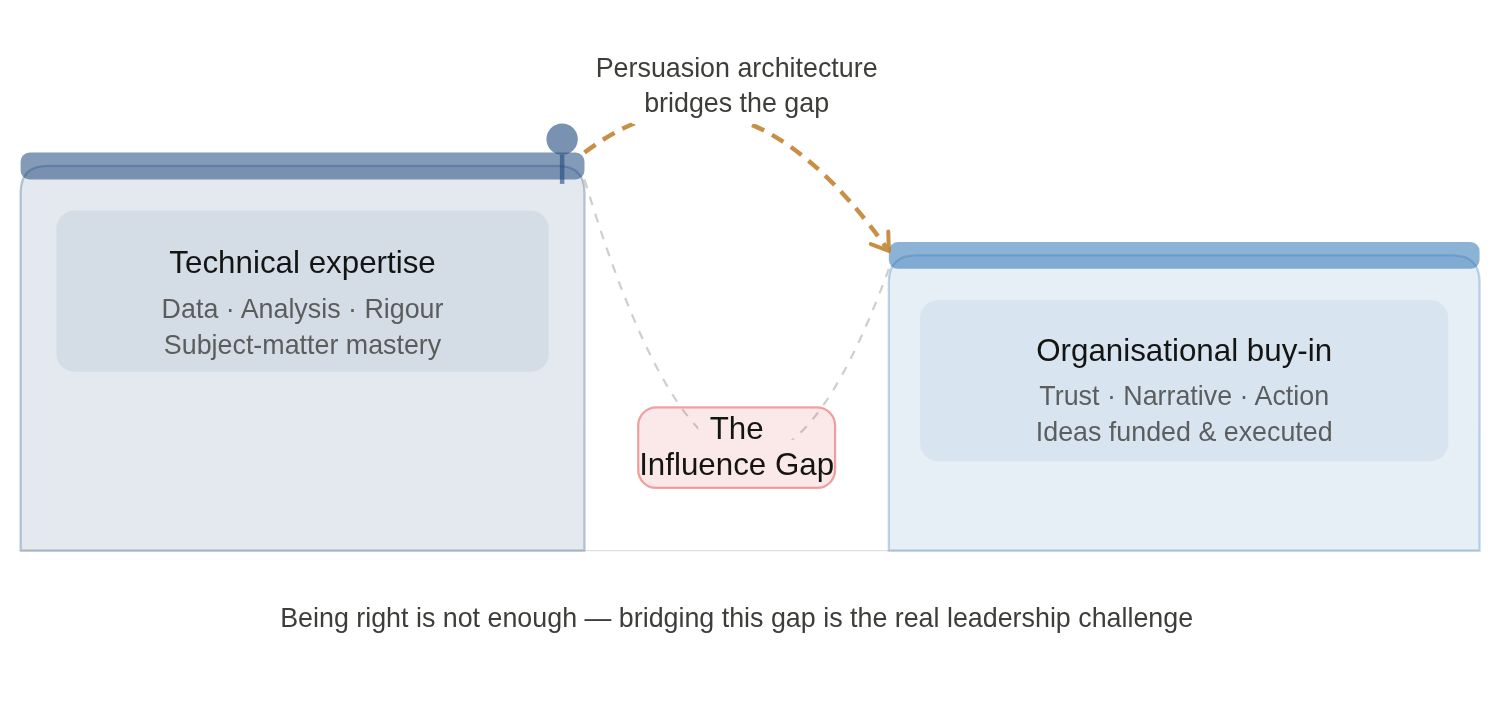
The answer rarely lies in the quality of her idea. It lies in the gap between being right and being persuasive. Between possessing knowledge and wielding influence. This is what organisational psychologists increasingly refer to as the Influence Gap — the invisible distance between technical expertise and the ability to move people, decisions, and resources in a desired direction.
And here is the uncomfortable truth: the Influence Gap is one of the most career-limiting, organisation-stalling challenges facing technically brilliant managers today. It is not a flaw of intelligence. It is a flaw of communication architecture. And like any architectural problem, it can be identified, understood, and fixed.
Before We Go Deeper — A Resource Worth Bookmarking
If you are a manager, team lead, or aspiring leader who recognises yourself in that boardroom scenario, you are not alone — and you are in the right place. The skills that close the Influence Gap fall squarely within the domain of modern leadership development. Our Management & Leadership training courses are designed precisely for professionals who are ready to bridge that gap — moving from being technically sound to strategically influential. Explore the full range of programmes and find the one that matches where you are in your leadership journey.
Understanding the Influence Gap
The Influence Gap does not appear overnight. It forms gradually, often invisibly, as technically gifted professionals are promoted into management roles on the strength of their subject matter expertise — and then discover that the skills that made them exceptional individual contributors are insufficient to make them effective leaders.
Think about how most people get promoted. They solve hard problems. They deliver results. They demonstrate mastery. And so the organisation rewards them with a title, a team, and a seat at the table where decisions are made. What the organisation rarely tells them is that the currency of that new room is not data — it is trust, narrative, and emotional resonance. And most technically minded managers have never been taught to speak that language.
Dr. Robert Cialdini, whose decades of research on influence and persuasion remain foundational in leadership science, identified that people make decisions based on a complex interplay of logic, emotion, and social proof. The mistake that technically brilliant managers consistently make is over-investing in logic and under-investing in the other two. They build bulletproof arguments and then wonder why they keep losing the vote.
The Three Symptoms of the Influence Gap
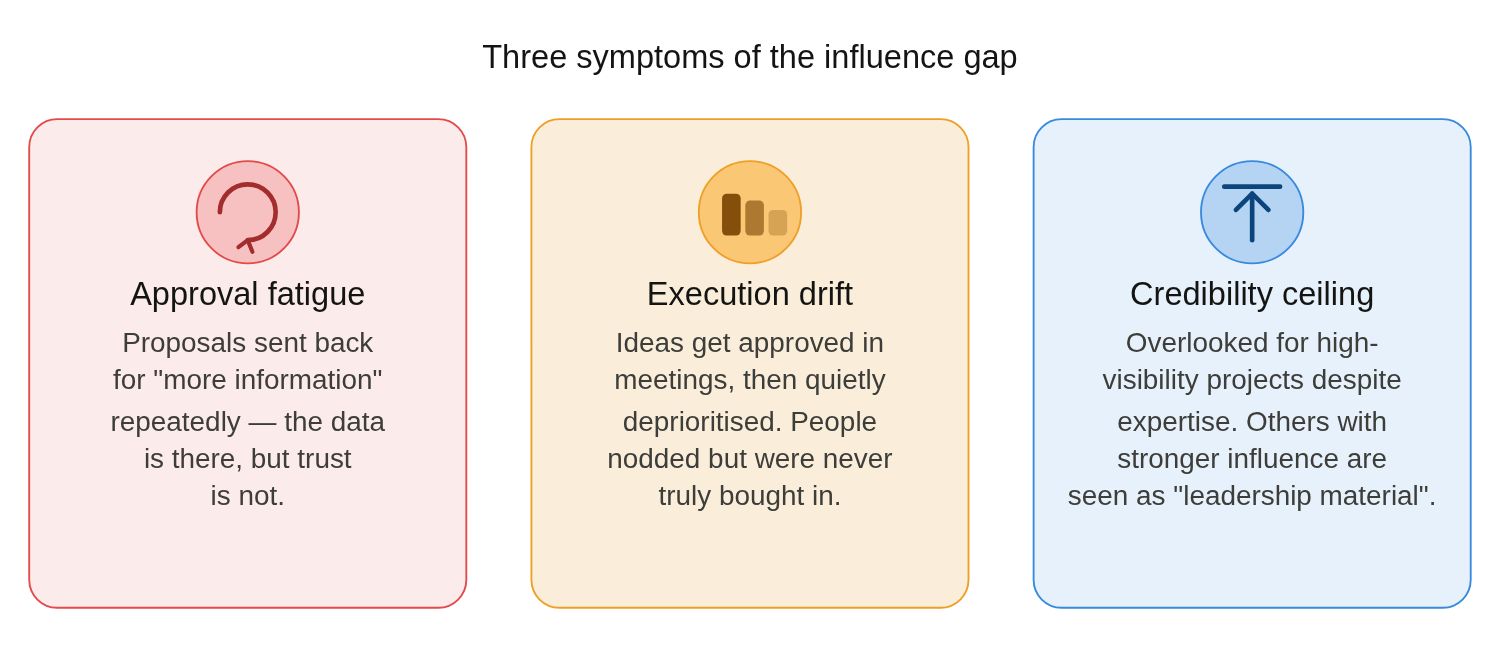
Before you can close the gap, you need to recognise it. The Influence Gap tends to manifest in three consistent, observable patterns:
- Approval Fatigue: Your proposals get sent back for 'more information' repeatedly, even when you believe the information is already there. Decision-makers are not actually asking for more data — they are signalling that they do not yet feel confident enough to say yes.
- Execution Drift: Your ideas get approved in meetings but quietly deprioritised in the weeks that follow. People nodded, but they were never truly bought in. Without genuine commitment, implementation stalls.
- Credibility Ceiling: Despite your expertise and track record, you consistently find yourself overlooked for high-visibility projects or senior conversations. Others — sometimes less technically capable — are seen as more 'leadership material.' What they actually have is stronger influence architecture.
If any of these feel familiar, you are experiencing the Influence Gap. And the good news is that each of these symptoms responds to the same underlying treatment: a deliberate, structured approach to persuasion.
Why Being Right Is Not Enough
There is a deeply held belief among technically trained professionals that if your argument is correct and your data is solid, the right outcome will follow naturally. This belief is understandable. It is also demonstrably false — and holding onto it is expensive.
Organisations do not run on logic alone. They run on relationships, priorities, politics, and perception. The best idea in the room is only as powerful as the trust the person presenting it has built, the timing of the pitch, and the degree to which decision-makers can see themselves and their priorities reflected in the proposal.
Consider two managers presenting the same infrastructure upgrade proposal to the same leadership team. Manager A presents a detailed technical brief with cost projections and risk matrices. Manager B opens with a story about a recent near-miss that kept the CEO up at night, frames the upgrade as the direct solution to that specific concern, acknowledges budget pressure by presenting a phased approach, and closes with a clear ask. Manager B gets the green light. Manager A gets a follow-up meeting.
The difference is not competence. It is persuasion architecture — the deliberate structuring of how an idea is presented, not just what the idea contains.
The Neuroscience Behind Buy-In
Modern neuroscience has given us remarkable insight into why some arguments land and others do not. When people are presented with pure data and analysis, the brain engages its analytical processing centres — but these are not the centres that drive decision-making. Decisions, as neuroscientist Antonio Damasio famously demonstrated through his somatic marker research, are fundamentally emotional processes that are then rationalised through logic.
This means that the manager who leads with a spreadsheet is, neurologically speaking, talking to the wrong part of the room. The manager who opens with a story, connects to a shared concern, or paints a vivid picture of what success looks like is activating the decision-making regions of the brain before the analytical justification is even delivered. The logic becomes confirmation, not cause.
This is not manipulation. It is alignment — aligning your communication approach with how human beings actually process information and commit to action. Brilliant managers who understand this shift from being presenters of data to architects of belief.
The Persuasion Architecture Framework
Closing the Influence Gap requires more than better presentation skills or a communication workshop. It requires a systematic rethink of how you construct and deliver ideas — what we call Persuasion Architecture. This framework has four foundational pillars, each of which addresses a different layer of the buy-in challenge.
Pillar 1 — Audience Intelligence
The first mistake most technically brilliant managers make is designing their communication for themselves — for the person who already understands and cares about the subject matter. Persuasion Architecture starts with a simple but demanding question: who specifically needs to say yes, and what does the world look like from their seat?
Effective audience intelligence means mapping the decision landscape before you enter the room. What are your key stakeholders currently most worried about? What metrics are they being measured on? What recent failures or near-misses are still fresh in their minds? What objections will surface, and who is most likely to raise them?
When you can answer these questions confidently, you stop presenting to a room and start speaking directly to individuals — and that shift in specificity is often the difference between a polite response and a genuine commitment.
Pillar 2 — Narrative Architecture
Data tells. Stories sell. This is not a critique of rigour — it is an acknowledgement of how human attention and memory actually work. The most influential communicators in business do not abandon data; they embed data inside a narrative structure that gives it meaning and momentum.
A well-built leadership narrative typically follows a recognisable arc: establish the current situation, identify the tension or problem that makes the status quo unacceptable, introduce your solution as the path through that tension, and close with a clear, specific ask. This structure — situation, complication, resolution, action — is not a formula for dumbing things down. It is a framework for making complexity accessible without losing its integrity.
The key is to make the complication personal and vivid. Not 'our system uptime is at 94.3%' but 'last Thursday, three of our largest clients could not access their accounts during peak trading hours — and two of them called your office directly.' One is a statistic. The other is a story that moves people.
Pillar 3 — Strategic Timing and Coalition Building
Influence rarely happens in a single meeting. The managers who consistently get buy-in understand that the real persuasion work happens in the conversations before the formal presentation — in the coffee catch-ups, the informal check-ins, and the quiet pre-reads with key decision-makers.
Coalition building is the practice of identifying and engaging your most important allies before you need their public support. When the CFO already knows your proposal is coming and has had his specific concern addressed one-on-one, he is far more likely to signal approval in the room — and that signal carries enormous weight with others.
Strategic timing matters just as much. Bringing a large capital request to a leadership team that has just been through a difficult quarter review is very different from presenting the same request immediately after a success story that has elevated the team's confidence. Reading the organisational temperature — and timing your influence accordingly — is a skill that separates good managers from genuinely effective leaders.
Pillar 4 — Objection Architecture
Most technically brilliant managers treat objections as obstacles — challenges to their argument that must be defeated. Influential leaders treat objections as intelligence — signals about what the other person needs in order to feel safe enough to say yes.
Objection Architecture is the practice of identifying the most likely objections in advance, designing your proposal to address them proactively, and creating space in your presentation for people to voice concerns without those concerns derailing the conversation.
A powerful technique here is the pre-emptive acknowledgement — naming a likely objection before anyone else raises it. 'I know what some of you might be thinking — this looks expensive in year one. Let me show you what the three-year picture looks like.' This approach does two things simultaneously: it demonstrates that you have thought deeply about the challenges, and it disarms the objection before it can gather momentum in the room.
From Influence to Execution: Sustaining Buy-In After the Meeting
Winning the room is only half the battle. Many managers discover, often painfully, that approval in a meeting and genuine commitment to execution are very different things. People can say yes because they feel social pressure to agree, because they want the meeting to end, or because they genuinely support the idea in the abstract but lack the motivation to prioritise it in practice.
Sustaining buy-in requires a deliberate post-decision influence strategy. This includes creating visible milestones that remind stakeholders of what they committed to, communicating early wins loudly and consistently, and giving key supporters a meaningful role in the execution so that they have a personal stake in the outcome.
It also means being willing to have the harder conversations when momentum stalls — not with frustration, but with curiosity. 'I noticed we haven't been able to progress on X — what's getting in the way?' is a far more effective re-engagement tool than a passive-aggressive status update email. Influential managers maintain the relationship even when they are pushing for progress.
Building a Culture of Influence Within Your Team
The Influence Gap is not only a personal challenge. It is an organisational one. When technically brilliant people across a team consistently struggle to get their ideas heard, the organisation systematically underinvests in its best thinking. Great ideas get buried. The loudest voices win, not the most rigorous ones. Innovation stalls.
Leaders who have closed their own Influence Gap have a responsibility — and an extraordinary opportunity — to help their teams do the same. This means creating structured space for team members to practise presenting ideas, coaching them on how to frame proposals for senior audiences, and modelling the behaviours of effective influence in your own leadership practice.
When influence becomes a team capability rather than an individual one, the entire organisation begins to move faster and more confidently. Good ideas find their way to the surface. Resources flow more efficiently. And the gap between having a vision and executing on it narrows dramatically.
Take the Next Step: Build Your Leadership Influence
Understanding the Influence Gap is the first step. Closing it requires deliberate, structured development — the kind of immersive, practical learning that translates directly into results in the boardroom, the one-on-one meeting, and the daily rhythm of leadership.
High Performance Leadership Course
The High Performance Leadership Course is designed for exactly the challenge this article has explored. It goes beyond conventional leadership theory to equip managers with a practical, immediately applicable toolkit for building influence, earning trust, and driving results through people.
This programme addresses the full spectrum of what it means to lead at a high level — from the internal dimensions of leadership mindset and emotional intelligence, to the external dimensions of stakeholder communication, negotiation, and cross-functional influence. Participants leave not just with ideas, but with a personal leadership strategy and a clear action plan for closing the gap between where they are and where they need to be.
Key areas covered in the programme include:
- Influence and persuasion frameworks for senior stakeholder environments
- High-stakes communication: structuring arguments that get approved
- Emotional intelligence and its role in building lasting trust
- Managing upwards, sideways, and across organisational boundaries
- Decision-making under pressure and leading through ambiguity
- Building high-performance team cultures rooted in accountability and agility
Whether you are a mid-level manager looking to break through your credibility ceiling, a senior leader seeking to sharpen your executive presence, or an organisation investing in the next generation of leadership talent, the High Performance Leadership Course offers a proven pathway to measurable growth. Explore the full course details and upcoming schedules to find the intake that works for you.
Closing the Gap
The Influence Gap is real, it is widespread, and it is costly — for individuals, for teams, and for organisations. But it is not permanent. Every element of effective influence can be learned, practised, and refined. The technically brilliant managers who close this gap do not become less rigorous or less data-driven. They become something more powerful: they become leaders whose rigour actually gets heard.
The boardroom is not won by the best argument. It is won by the person who has done the invisible work — understanding the audience, building the coalition, framing the narrative, and making it easy for people to say yes. That work is learnable. And it begins with the decision to take influence as seriously as you have always taken expertise.
The gap is not a permanent feature of who you are. It is a distance. And distances can be crossed.

Frequently Asked Questions
Q1: What exactly is the Influence Gap, and how does it affect managers?
The Influence Gap refers to the disconnect between a manager's technical expertise and their ability to translate that expertise into decisions, approvals, and action. It affects managers by causing their best ideas to be overlooked, delayed, or deprioritised — not because the ideas are flawed, but because they are not being communicated in a way that moves people to act. The gap is particularly common among professionals promoted for technical excellence who have not yet developed the interpersonal and strategic communication skills that senior leadership requires.
Q2: Can influence skills be learned, or are they innate personality traits?
Influence skills are absolutely learnable — this is one of the most important findings from decades of leadership research. While some individuals may have natural communication tendencies that give them a head start, the core competencies of effective influence — audience analysis, narrative construction, objection management, and coalition building — are all structured skills that respond to deliberate practice and quality coaching. Structured leadership development programmes consistently produce measurable improvements in participants' ability to persuade and gain buy-in, regardless of their starting point.
Q3: Why do technically brilliant managers so often struggle with leadership influence?
The challenge is largely a product of how technical professionals are trained and rewarded throughout their careers. Technical disciplines reward precision, rigour, and the ability to defend an argument with evidence. Leadership influence, by contrast, requires empathy, narrative flexibility, and the willingness to meet people where they are emotionally and cognitively — not just where the data points. Most technically trained managers have never been explicitly taught these skills, because their professional development path did not require them until they reached management level.
Q4: What is the most common mistake managers make when trying to get buy-in for an idea?
The most common mistake is leading with data before establishing relevance. Managers often assume that if the evidence is strong enough, the decision will follow automatically. In practice, stakeholders need to care about the problem before they can engage with the solution. Leading with a story, a consequence, or a question that connects to something the audience already cares about is far more effective than opening with a data set — even a compelling one. The data should serve as confirmation of a decision the audience is already emotionally inclined to make.
Q5: How long does it typically take to close the Influence Gap through focused development?
This varies by individual, context, and the intensity of the development approach. Managers who engage in structured leadership programmes and apply the learning actively in their day-to-day roles often report meaningful shifts in their influence effectiveness within three to six months. Full integration of advanced influence strategies — particularly in complex, high-stakes stakeholder environments — typically develops over one to two years of consistent practice. The key accelerator is deliberate application: practising the skills in real situations, seeking feedback, and refining the approach iteratively.
Q6: How does emotional intelligence relate to leadership influence?
Emotional intelligence (EQ) is one of the foundational enablers of effective leadership influence. Self-awareness allows leaders to recognise how their communication style is landing and adapt accordingly. Empathy enables them to genuinely understand the concerns and priorities of their stakeholders, which is essential for crafting proposals that resonate. Social awareness helps leaders read the room accurately — sensing resistance, identifying allies, and knowing when to push and when to listen. Without a reasonable level of EQ, even the most technically sound persuasion framework will feel mechanical and fail to build the authentic trust that lasting influence requires.